
An AI engine optimization audit evaluates brand visibility, accuracy, and citations in AI-powered search engines. It highlights how a brand appears across ChatGPT, Gemini, Perplexity, and Bing Copilot, and identifies gaps in the facts, descriptions, and links these systems rely on. In contrast, a traditional SEO audit focuses on website rankings and technical health in classic search engines. 
AI search extracts information directly from content, public sources, and structured data. This shift changes how buyers discover brands and validate solutions. Growth-focused teams benefit from precise, consistent brand details in AI summaries, as these summaries influence early research, shortlists, and pipeline creation.
This post gives teams a complete workflow for running an AI engine optimization audit, priority fixes, a practical checklist, and the HubSpot tools that support the process. Each section offers clear steps for testing visibility across AI engines, measuring accuracy, updating content, and publishing structured, AI-friendly pages at scale.
Table of Contents
- What is an AI engine optimization audit?
- Why run an AI engine optimization audit now?
- How to Run an AEO Audit (Step-by-Step)
- Priority Fixes After Your Answer Engine Optimization Audit
- AI Search Optimization Audit Checklist
- Frequently Asked Questions About AI Engine Optimization Audits
What is an AI engine optimization audit?
An AI engine optimization audit is a structured review that measures how accurately AI search engines represent a brand. It evaluates visibility, accuracy, and citations across systems like ChatGPT, Gemini, Perplexity, and Bing Copilot. The goal is to confirm that AI-generated summaries accurately reflect the brand’s facts, product details, and sources.
An AI engine optimization audit differs from a traditional SEO audit. A traditional SEO audit focuses on rankings, crawlability, and technical health. An AEO audit focuses on entity correctness, brand mentions, citation frequency, and the precision of AI-generated summaries. An AI engine optimization audit identifies outdated facts, missing brand mentions, and incorrect citations in AI summaries. These issues often stem from unstructured pages, unclear entities, and inconsistent context.
AI engines pull information from standalone chunks, structured data, and patterns across the web. They interpret content more accurately when pages use clear headings, defined entities, semantic triples, and consistent formatting.
HubSpot Search Grader provides a free way to assess brand visibility in AI search engines and establish a fast baseline. It complements foundational work such as running a website audit, improving the fundamentals in the technical SEO guide, adding markup from the structured data walkthrough, and reviewing performance in your SEO report.
How AEO, GEO, and SEO Work Together
AEO, GEO, and SEO each strengthen how buyers discover and understand a brand.
- AEO (answer engine optimization) focuses on entity clarity, accurate citations, and how AI engines summarize a brand.
- GEO (generative engine optimization) focuses on performance in generative experiences across channels, including conversational answers and synthesized results.
- SEO (search engine optimization) focuses on rankings, crawlability, and technical performance in traditional search engines.
Teams gain stronger visibility when these workflows run together. AEO highlights entity gaps. GEO highlights the depth and usefulness of content in generative environments. SEO highlights technical and ranking signals. Adding all three dimensions to your SEO report helps teams track visibility changes across search experiences.
| Audit Type |
What the Audit Covers |
Why It’s Important |
| AEO (Answer Engine Optimization) |
Entity definitions, brand mentions, citations, factual accuracy, and how AI systems interpret and summarize the brand |
Ensures AI engines clearly understand who a brand is, what it offers, and when to reference the brand in direct answers and summaries |
| GEO (Generative Engine Optimization) |
Performance in generative experiences, including conversational responses, synthesized results, multi-source answers, and content usefulness |
Improves visibility and influence in AI-driven discovery moments where users receive generated answers instead of links |
| SEO (Search Engine Optimization) |
Rankings, crawlability, indexing, site architecture, technical health, backlinks, and keyword performance |
Maintains strong visibility in traditional search results and ensures content can be discovered, indexed, and ranked effectively |
Why run an AI engine optimization audit now?
AI search now plays a significant role in how buyers research categories, compare vendors, and validate solutions. An AI engine optimization audit gives teams a clear understanding of how AI engines summarize their brand today and where improvements will have the greatest impact.
AI search is reshaping top-of-funnel discovery.
Traffic is harder to earn as AI engines become the first stop for contextual answers. Large language models (LLMs) generate tailored responses that provide users with direct guidance, reducing the need to interact with traditional SERP links. Strong AEO foundations help AI engines highlight accurate facts and updated messaging.
AI engines influence B2B buying committees.
AI summaries often appear before buyers reach a website. These early summaries shape category expectations, frame key capabilities, and affect which vendors appear relevant. AEO improvements support more consistent visibility in these moments.
Incorrect or missing brand facts spread quickly.
AI engines absorb outdated information from old pages, legacy listings, and external sources. Those inaccuracies can spread across multiple systems. Publishing consistent, structured updates helps guide AI engines toward current facts.
Pipeline and revenue reporting needs accurate AI mentions.
Pipeline creation depends on how clearly buyers understand a brand’s offerings. Updated AI summaries support more consistent messaging across the funnel. Smart CRM connects content improvements to pipeline and revenue outcomes, which links AEO efforts to measurable business impact.
AI search optimization compounds over time.
Clear entity signals help AI engines categorize a brand more accurately. Early improvements create a foundation that strengthens recognition and citation patterns across future updates.
How to Run an AEO Audit (Step-by-Step)
An AEO audit evaluates how AI engines describe a brand, highlights errors, and guides updates that strengthen visibility. Each step works as a standalone task that teams can complete in sequence or integrate into existing content workflows.
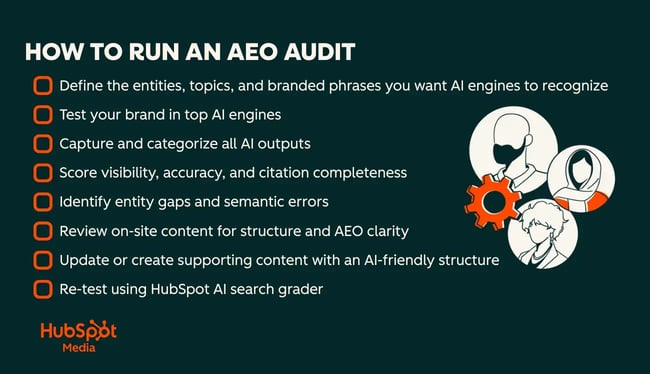
Step 1: Define the entities, topics, and branded phrases you want AI engines to recognize
List the core facts AI engines should reference when summarizing your brand. Include company name, product names, key features, target personas, and category terms. Add high-intent topics that align with your positioning.
Step 2: Test your brand in top AI engines
Run targeted prompts across ChatGPT, Gemini, Perplexity, and Bing Copilot. Include private or industry models if relevant to your audience. Test branded queries, category queries, and solution-driven prompts. Teams evaluating Microsoft’s ecosystem can also reference our guidance on whether marketers should optimize for Bing.
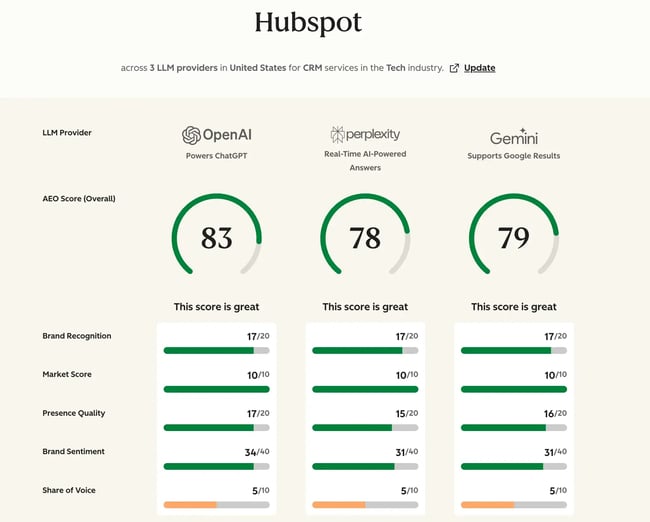
Pro tip: Use HubSpot’s free AEO Grader to see how your website is appearing in AI search engines.
Step 3: Capture and categorize all AI outputs
Record screenshots and text from each engine. Categorize outputs as correct, outdated, incomplete, inaccurate, or missing. Add a column for confidence markers such as citations, links, attributed sources, and contextual accuracy.
Pro tip: Add a confidence-marker column to highlight which engines pull from trustworthy sources.
Step 4: Score visibility, accuracy, and citation completeness
Create a simple scoring model for visibility, accuracy, depth, and citations. Visibility measures whether the brand appears. Accuracy measures factual correctness. Depth indicates whether product-level details appear. Citations measure whether AI engines link to brand-owned sources.
Step 5: Identify entity gaps and semantic errors
Check for incorrect founders, dates, product descriptions, or industry categories. Flag missing features, outdated positioning, and expired pricing. This step surfaces unclear or inconsistent entity signals.
What I like: Entity-gap reviews often reveal inconsistencies across About pages, product pages, and listings. Updating these hubs simultaneously strengthens AEO, SEO, and GEO signals.
Step 6: Review on-site content for structure and AEO clarity
Evaluate whether the content uses extractable chunks, clean H2/H3 formatting, lists, and explicit semantic triples. Review internal linking and entity details across key pages. Strengthen structured data using the practices in HubSpot’s structured data guide. HubSpot Content Hub supports structured, entity-friendly publishing at scale.
Step 7: Update or create supporting content with an AI-friendly structure
Draft updates using AI tools, then manually validate each fact. Breeze AI Suite accelerates content briefs, QA pairs, and optimization tasks. Content Hub and Marketing Hub help teams blend SEO and AEO updates with structured editing tools and performance insights.
Best for: Teams managing large content libraries benefit most from drafting first-pass updates in Breeze and refining with human review.
Step 8: Re-test using HubSpot AI search grader
Run another full test using HubSpot Search Grader after publishing updates. Record changes, compare outputs, and refine your entity list as the brand evolves. An AI engine optimization audit should be repeated quarterly or after major content changes.
How to Operationalize Your AEO Audit in HubSpot
HubSpot’s ecosystem supports the entire AEO workflow:
- AI Search Grader establishes baselines for visibility, accuracy, and citations.
- Content Hub publishes structured, entity-friendly updates.
- Breeze AI Suite speeds up content briefs, revisions, and QA tasks.
- Marketing Hub SEO tools highlight technical issues and topic gaps that support AEO and SEO work.
- Smart CRM connects content updates to engagement, lead quality, and revenue insights.
Best for: Teams that want a repeatable AEO workflow tied directly to content operations and reporting.
Priority Fixes After Your Answer Engine Optimization Audit
High-impact fixes focus on correcting brand facts, strengthening entity clarity, publishing structured content, expanding high-intent coverage, updating public listings, and adding authoritative citations.
Fix 1: Correct brand facts across owned content.
Update outdated product descriptions, feature lists, and claims. Add semantic triples that clearly establish relationships among the brand, its products, and its categories.
Pro tip: Add semantic triples to product pages, About pages, and glossary entries to strengthen entity clarity.
Fix 2: Strengthen entity pages and brand hubs.
Clarify who the brand serves, what categories it participates in, and which products it offers. Strengthen About pages, glossary entries, and product pages so AI engines have reliable sources for the fundamentals.
Fix 3: Add structured data and better content architecture.
Publish schema markup for entities, products, and organizational details. Strengthen the information architecture so AI engines can interpret the site structure quickly. HubSpot’s structured data guide outlines markup patterns teams can operationalize across the site.
What I like: Structured data often becomes one of the fastest ways to correct misaligned AI-generated facts.
Fix 4: Create supporting content for high-intent topics.
Expand content to align with buyer needs in AI engines. Add explainers, templates, guides, and updated category pages. Marketing Hub’s SEO recommendations highlight topic gaps and content opportunities.

Best for: Teams building topic authority across hybrid AEO and SEO workflows.
Fix 5: Update digital footprints on high-authority platforms.
Refresh brand information across LinkedIn, G2, GitHub, YouTube, and other profiles AI engines frequently reference. Create a Wikipedia page only if the brand meets notability standards and can follow editorial guidelines.
Fix 6: Add earned media and authoritative citations.
Strengthen presence across reputable outlets, including press outlets, podcasts, and interviews. AI engines favor brands with consistent external validation.
Pro tip: Earned media improves citation patterns and reduces outdated references across AI engines.
AI Search Optimization Audit Checklist
Use this AEO audit checklist as a repeatable monthly or quarterly workflow.
- Identify core entities to evaluate.
- Test visibility in top AI engines.
- Capture and categorize outputs.
- Score visibility, accuracy, and citations.
- Fix entity and semantic errors.
- Update content structure and metadata.
- Add structured data and entity markup.
- Re-test with HubSpot AI Search Grader.
- Repeat every quarter.
Frequently Asked Questions About AI Engine Optimization Audits
Teams encounter several common questions when they begin evaluating how AI engines summarize their brand.
Do I need developer resources for an AI engine optimization audit?
Developer support is not required for the evaluation itself. Developer resources can help when adding structured data, updating schema markup, or adjusting site architecture that supports clearer entity signals.
How often should I rerun the audit?
Run the audit quarterly or after major content, product, or positioning updates. This rhythm keeps AI-generated summaries aligned with your current brand details.
Should I create a Wikipedia page for my brand?
Create a Wikipedia page only if the brand meets notability criteria and can follow editorial standards. Pages that do not meet these requirements may be removed, creating confusion for AI engines.
Will llms.txt impact traditional seo?
llms.txt manages access for AI crawlers and does not impact Google’s ranking algorithms. It operates independently of traditional SEO signals.
What’s the best way to get cited by AI engines faster?
Publish structured, entity-rich content with clear semantic relationships. Strengthen external citations from reputable outlets. Use HubSpot AI Search Grader to identify gaps and plan updates.
Getting Started
An AI engine optimization audit highlights how AI search engines describe a brand, identifies accuracy gaps, and guides updates to improve visibility across the buyer journey. The shift toward AI-generated summaries makes this work an important part of discovery, revenue creation, and growth planning. Get started by defining core entities, testing visibility across major AI engines, and running an initial baseline with HubSpot AI Search Grader.
I’ve seen significant improvements from teams that adopt a consistent audit cycle, update outdated facts, and publish structured content — small improvements compound. AI engines update their summaries quickly when brands publish clear, reliable information in structured formats.
